
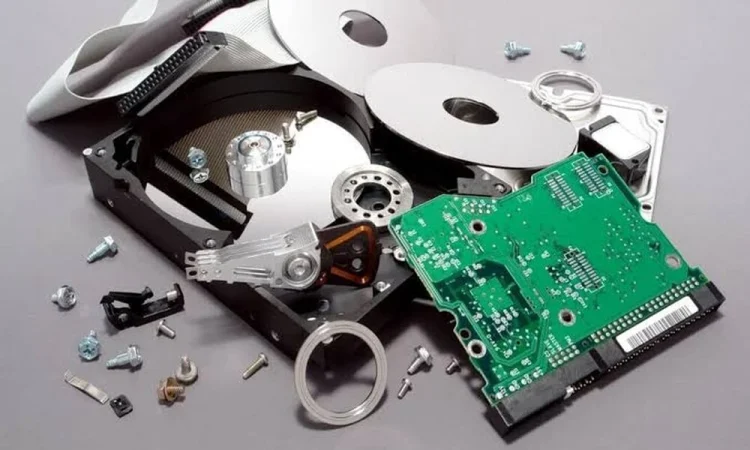
There is a tendency to treat physical destruction as the default end for every retired drive, on the reasoning that nothing can be recovered from fragments. That is true, but it is also wasteful when a verified wipe would have done the job and left a usable machine behind. A hard drive destruction service earns its place in specific circumstances: when a drive cannot be erased, when the data is too sensitive to risk, or when a rule says so.
Destruction Versus Erasure
Erasure overwrites or cryptographically wipes a working drive and confirms the result with a report, after which the hardware can be reused. Destruction makes the media physically unreadable by shredding, crushing or disintegrating it. Both are legitimate ways to sanitise storage. The difference lies in what remains afterwards and in how the outcome is proven. Erasure depends on software reaching every part of the drive. Destruction depends on nothing except the size of the pieces left behind.
When the Drive Has Failed
A drive that no longer spins up, reports bad sectors or is not recognised by the controller cannot be reliably overwritten, because the erasure tool cannot write to areas it cannot reach. The data on those platters or chips is still present, and a recovery laboratory may be able to read it even though the owner cannot. Failed drives are therefore the clearest case for destruction. They should never be returned under warranty or discarded without being sanitised first.
When the Data Classification Demands It
Some information carries consequences severe enough that even a small residual risk is unacceptable. Patient records, payment card data, legal case files, source code, defence-related material and large customer databases often fall into this group. Many organisations write into their data classification policy that media holding the top tier must be destroyed regardless of condition or resale value. Where such a policy exists, the decision has already been made and should not be reopened drive by drive.
When Contracts or Regulators Specify It
Requirements often come from outside the organisation. Client contracts, particularly with banks, public agencies and multinational customers, may state that storage media used for their data must be physically destroyed and a certificate supplied. Sector regulators and industry standards can impose similar terms. In these cases the method is not a matter of preference, and using providers of certified it asset disposition itad solutions gives the audited process and paperwork that such clauses usually expect to see.
When the Hardware Has No Resale Value
Erasing a drive takes time, and for large-capacity disks it can take many hours per unit. That effort is justified when the drive or its host machine will be sold or redeployed. It is hard to justify for small, slow or obsolete drives that nobody would buy. Where the hardware is destined for recycling anyway, shredding is usually the quicker and cheaper route to the same outcome, and it removes any doubt over whether the wipe completed properly.
When Media Cannot Be Reliably Overwritten
Certain media types resist software erasure. Older solid state drives may hold remnants of data in spare cells that an overwrite does not touch. Damaged USB sticks, memory cards, optical discs and some backup tape formats present similar difficulties. Hybrid drives and drives locked by forgotten firmware passwords add further complications. When there is no dependable way to confirm that every storage location has been cleared, destruction to an appropriate particle size is the only method that offers certainty.
What Happens During a Destruction Job
A typical job begins with the drives being counted and their serial numbers scanned at the point of collection. They are placed in locked containers and either processed immediately in a mobile unit or transported to a secure facility. Each drive is scanned again before it enters the shredder or crusher, so the record ties the individual device to the moment it was destroyed. The customer’s representative may watch in person or, at some facilities, through recorded video.
Evidence You Should Receive Afterwards
The job is not finished until the paperwork arrives. Expect a certificate of destruction listing every serial number, the method and particle size where relevant, the date, the location and the operator responsible. A reconciliation against your own asset list should show that the number collected equals the number destroyed. Photographs or video may be included. File these records with your asset register, because they are what an auditor or regulator will ask for after an incident.
What Happens to the Fragments
Shredded drives are not waste in the ordinary sense. The fragments contain aluminium, steel, copper, rare earth magnets and small amounts of precious metal from the circuit boards, all of which can be separated and recovered. Reputable it asset disposal services send this material to licensed recyclers and can state where it goes. Ask the question directly, because responsibility for sound environmental handling does not end once the data has been dealt with.
A Simple Test for Deciding
For each batch of drives, ask four questions. Does the drive work well enough to be erased and verified? Is the data ordinary enough that a verified wipe satisfies policy? Is there no contract or regulation requiring physical destruction? Does the hardware have any reuse value? If every answer is yes, erasure and reuse is the sensible course. A single no points towards destruction, carried out by a provider who will document each drive individually.